
Pyrum Innovations entered into market making agreement with Pareto Securities

Pyrum Innovations AG (Pyrum), a pioneer in the sustainable recycling of end-of-life tires (ELT) based on its patented tire pyrolysis technology, has entered into a market making agreement with Pareto Securities AS. The purpose of the agreement is to enhance liquidity in the trading of the Company's shares. The agreement is in accordance with the standard requirements of Euronext Oslo Stock Exchange. First day of market making was on 27
About Pyrum Innovations AG
Pyrum Innovations AG is active in the attractive recycling market for end-of-life-tires with its patented pyrolysis technology. Pyrum's pyrolysis process is reported to be completely energy self-sufficient, saves up to 98% of the CO2 emissions normally generated during the combustion of end-of-life tires in a cement plant and produces new raw materials such as pyrolysis oil, gas and recovered carbon black from the waste used as input materials. In this way, Pyrum closes the recyclable material loop and pursues a completely sustainable business model. As a pioneer, Pyrum Innovations AG was the first company in the end-of-life tire recycling sector to receive REACH registration from the European Chemicals Agency (ECHA) for the pyrolysis oil it produces. This means that the oil is recognized as an official raw material and can be used as a raw material in production processes. In addition, Pyrum is continuously researching both new input materials as well as new raw materials to be produced, for example with the ongoing tests for the extraction of hydrogen from the gas obtained by means of the patented technology. These achievements have also been recognized by international experts in the tire industry. For example, Pyrum won the Best Tyre Recycling Innovation category at the inaugural Recircle Awards and has been nominated for the "Grand Prix Mittelstand" ("Großer Preis des Mittelstandes") from the German state of Saarland.
Press release by Pyrum Innovations.
Weibold is an international consulting company specializing exclusively in end-of-life tire recycling and pyrolysis. Since 1999, we have helped companies grow and build profitable businesses.

Sponsored
Industry's News and Events
Subscribe for Weibold's monthly newsletter to receive the most important news on market trends, technology advances, expos, trade shows and conferences related to tire recycling and pyrolysis industry and much more!
Newsletter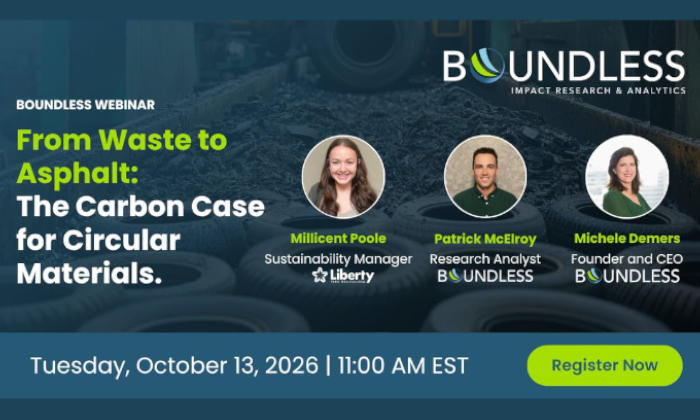
Webinar by Boundless and Liberty Tire Recycling to present LCA results for recycled rubber products – October 13, 5pm CEST
Boundless will host a webinar with Liberty Tire Recycling examining how lifecycle assessment can be used to quantify and substantiate the environmental benefits of recycled rubber products. The session will present a recent LCA covering four recycled-rubber products and explain how their greenhouse gas impacts were compared with the conventional materials they replace. The webinar is intended to address an important issue for tire recycling and circular economy markets: recycled content alone does not automatically demonstrate a lower carbon footprint, and environmental claims need to be supported by transparent methodology, credible baseline comparisons and data capable of withstanding external review. Millicent Poole, Sustainability Manager at Liberty Tire Recycling, will discuss how the assessment results are being used commercially, while Boundless Founder and CEO Michele Demers and Research Analyst Patrick McElroy will explain the methodology behind the calculations, including approaches to avoided emissions and auditable sustainability claims.
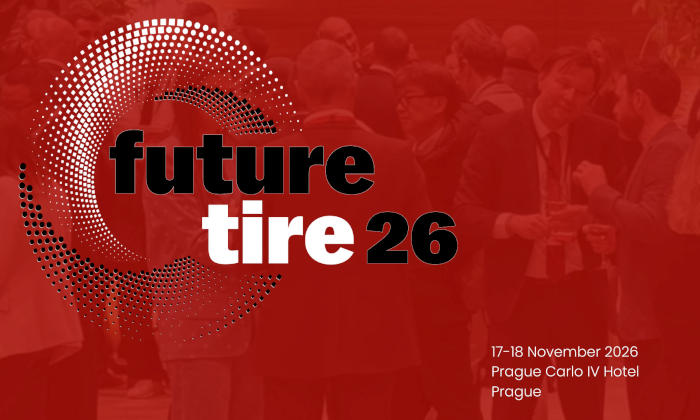
Future Tire Conference 2026 to focus on turning innovation into competitive advantage – Prague, November 17-18
From AI and automation to sustainability, advanced materials, energy systems and circularity, manufacturers face mounting pressure to ensure that investment in innovation translates into productivity, resilience and profitability. The Future Tire Conference 2026 will bring together senior leaders from across the tire, automotive, materials, chemicals and equipment sectors to examine how the industry can successfully deploy and scale the technologies shaping its future.
HITEC Luxembourg highlights quality control needs for recovered carbon black
Recovered carbon black can vary significantly depending on tire feedstock, pyrolysis conditions, milling, pelletizing and post-processing. These variations can influence handling, dispersion and final rubber performance, making quality control essential for producers seeking approval from tire and rubber manufacturers.