TSA says Australia's tyre circular economy cannot grow without mandatory participation scheme

Tyre Supply Chain Analysis identifies 33 key issues constraining circularity, with only 26% of Australia’s end-of-life tyres currently reused or recycled.
A comprehensive new report released today by Tyre Stewardship Australia (TSA) has found that Australia's tyre circular economy will not grow without mandatory participation in a product stewardship scheme. The Tyre Supply Chain Analysis: Opportunities to grow Australia's circular economy for tyres report identifies critical constraints across the entire tyre supply chain that are preventing Australia from meeting its circular economy targets.
The report reveals that companies responsible for 47% of replacement tyre imports and 99% of vehicle-fitted tyre imports do not contribute to Australia's voluntary stewardship scheme levy, creating an uneven playing field where responsible importers are penalised while free-riders benefit from scheme programs at no cost.
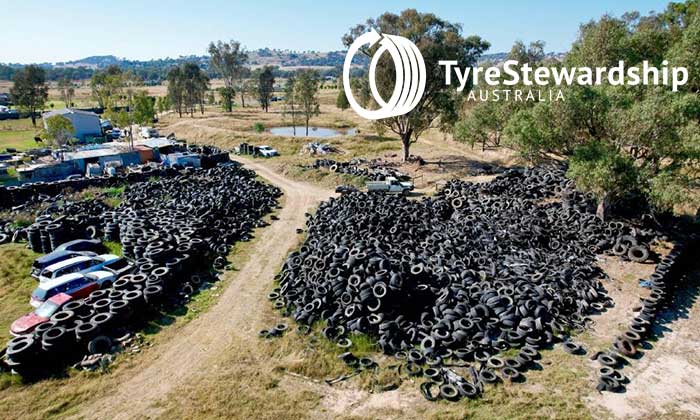
With approximately 537,000 tonnes of end-of-life tyres generated annually in Australia, only 26% are reused (9%) or recycled (17%), while 40% are exported for energy recovery and the remainder either landfilled, buried on-site at mines, stockpiled or illegally dumped.
The analysis identified 33 key issues constraining greater circularity, including six rated as "Very High" constraints that represent critical systemic failures.
The six most critical constraints identified are:
- Free-riding importers — 47% of replacement and 99% of fitted tyre imports avoid the Scheme levy, gaining an unfair financial advantage
- Rogue collectors — unaccredited operators undercut legitimate collections, leading to illegal dumping with significant community, environmental, and financial impacts
- Onsite burial at mines — 100,000 tonnes of mining tyres are permitted to be buried annually despite available recovery options
- On-farm dumping and burning — prohibitive collection costs drive routine dumping and burning of large off-the-road tyres on farms
- Low recycling rates — Australia recycles just 17% of used tyres, with 40% going to energy recovery and 30% to burial and landfill
- Underdeveloped circular end markets — growth is held back by insufficient procurement of tyre-derived material, over-reliance on energy recovery, and the continued permitting of OTR tyre burial
The report examined current and potential opportunities to resolve these constraints but identifies a mandatory participation scheme – at either national or jurisdictional level – as the most effective solution.
"While joint TSA–State/Territory programs could be pursued, and amendments to the existing voluntary scheme are recommended, the report is clear that optimising the current voluntary approach will only drive limited growth," said Lina Goodman, CEO of Tyre Stewardship Australia.
"A regulated scheme fit-for-purpose in the Australian context – designed across the entire supply chain, supported by incentives, and staged where necessary to reflect market readiness – is essential if tyres are to meaningfully contribute to Australia's circular economy targets."
Goodman noted that existing legislation, including the Recycling and Waste Reduction Act 2020 and the NSW Product Lifecycle Responsibility Act 2025, could support such a scheme, yet this has not occurred despite tyres being on the Minister's Priority List since 2022–23.
"The report's findings are unequivocal. Australia's tyre supply chain is constrained from achieving high levels of material circularity due to fragmented policies, laws, implementation and enforcement across all levels of government. Without mandatory participation, the current Scheme simply cannot deliver the circularity rates called for by the Government's framework."
The findings align with the Australian Government's 2024 Circular Economy Framework commitment to double Australia's circularity rate, which includes reducing material footprint by 10%, lifting materials productivity by 30%, and safely recovering 80% of resources. The report concludes that tyres represent a product group that can contribute significantly more to measurable increases in material circularity.
The report's conclusions are consistent with the recent Western Australian Government's National End-of-Life Tyres Options Report, which also found that a well-designed regulated product stewardship scheme tailored to the Australian context is required to address free-riding, inadequate collections, underdeveloped processing markets, ongoing disposal of OTR tyres and ultimately improving tyre circularity outcomes.
"The time for researching and reporting is over," Goodman commented. “Industry has already invested millions in tyre recycling infrastructure in anticipation of the stronger regulation that government has long signalled is coming. What we need now is commitment from the Federal and State governments to implement mandatory participation in a product stewardship scheme for tyres. Only government can take the next necessary step: the time for action has come."
The full report, Tyre Supply Chain Analysis: Opportunities to grow Australia's circular economy for tyres, is available on the TSA website.
Background on Tyre Stewardship Australia
Australia’s tyre product steward was established in 2014 to implement the national Tyre Product Stewardship Scheme (TPSS) – an ACCC-authorised industry framework to reduce the environmental, health and safety impacts of the 56 million Equivalent Passenger Units (EPUs) which reach their end of life in Australia each year.
TSA’s vision is of a circular economy for end-of-life (EOL) tyres that contribute to a sustainable society. It works all along the tyre supply chain to minimise waste and increase value for government, industry, businesses, and consumers, by:
- Accrediting and monitoring compliance of TPSS participants – now 1,700 and counting, including tyre manufacturers, retailers, collectors, and recyclers who are committed to sustainable practices.
- Working with levy contributors to invest in market development initiatives – up to $10 million invested to date, including:
- Research and development.
- Commercialisation of new, productive uses for EOL tyres driving the transformation of a waste product into a useful commodity, creating new industries and jobs while reducing the environmental harm caused by the illegal dumping of old tyres.
- Providing a range of ESG tools and services for use by government, industry, R&D and consumers, including:
- Foreign End Market Verification (FEMV) platform – the only global platform that verifies Australian-generated end-of-life-tyres are not causing environmental or social harm at their final destination.
- Sustainable Outcomes Indicator star rating which drives and promotes best practice operations and the development and use of tyre-derived materials and products in the Australian market.
- Circular Economy Collaborator platform which supports products manufactured in Australia using Australian-made tyre-derived material.
TSA's report Tyre Supply Chain Analysis
Official press release by TSA.
Weibold is an international consulting company specializing exclusively in end-of-life tire recycling and pyrolysis. Since 1999, we have helped companies grow and build profitable businesses.