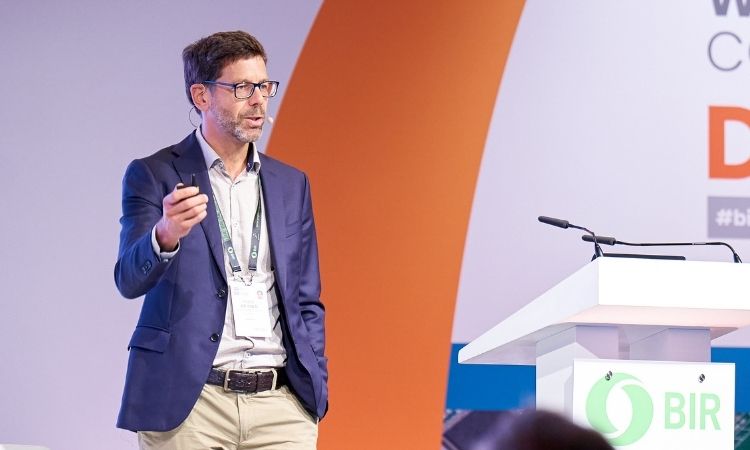
Vittorio Marangoni discusses EcoPneus role and European tire recycling challenges

Vittorio Marangoni, CEO of Marangoni and newly appointed President of EcoPneus, has discussed his new role in Italy’s end-of-life tire management system in Episode 93 of The Tyre Recycling Podcast, recorded at The Tire Cologne. Speaking with Richard Wilson, Marangoni addressed how he intends to lead Italy’s major extended producer responsibility consortium while continuing his work in the retreading sector. The discussion covered EPR stewardship, casing reuse, waste prevention, downstream demand for recycled tire materials, anti-free-rider measures, Digital Product Passports, regional collection quotas and the role of Life Cycle Assessment in tire recycling policy. The episode presents Marangoni’s appointment as significant for Italy’s tire recycling ecosystem, where retreading, material recovery, energy recovery, traceability and circular economy goals must be balanced across the value chain.
Episode 93 of The Tyre Recycling Podcast.
EcoPneus leadership linked to retreading expertise
Marangoni used the podcast to explain how his experience in retreading can support his work as President of EcoPneus. Retreading is closely linked to waste prevention because it extends the life of suitable tire casings before they become end-of-life tires. According to the episode summary, Marangoni also discussed how he manages potential conflicts of interest between his leadership in the retreading sector and his role in an EPR consortium responsible for broader tire recycling and recovery outcomes.
Podcast covers EPR stewardship and circularity
The episode, titled “EPR Stewardship & Circularity: Vittorio Marangoni on Closing the European Loop,” focuses on operational and regulatory developments in the tire recycling sector. Marangoni discusses his goals as EcoPneus President, alignment with board guidelines and the role of EPR agencies in managing end-of-life tire systems. The discussion also addresses how EPR organizations balance recycling and energy recovery within the waste hierarchy.
European circular economy gaps discussed
Marangoni identified downstream demand as one of the structural challenges facing Europe’s tire recycling market. According to the episode summary, he argued that a lack of demand from the chemical industry, rather than insufficient recycling capacity, is one of the main obstacles preventing circular economy loops from closing. This issue affects the ability of tire recycling companies to place recovered materials into higher-value applications and develop more stable long-term markets.
Traceability and free riders remain key issues
The podcast also explores Italy’s measures to address free riders in the end-of-life tire system. These include RENAP, a public registry intended to improve oversight, and the potential of Digital Product Passports to strengthen tire traceability. Improved traceability could help authorities and EPR systems track tires more effectively from market placement through collection, retreading, recycling and recovery.
Regional collection quotas aim to address imbalances
Marangoni also discussed regional collection disparities in Italy. New regional collection quotas are intended to reduce imbalances between urban areas and more remote regions, where end-of-life tire collection can be more difficult. The episode also covers the tracing of retread casings as a possible factor in balancing regional collection responsibilities and improving system fairness.
Life Cycle Assessment and waste hierarchy examined
The episode includes discussion of Life Cycle Assessment and how it should be considered alongside waste hierarchy priorities. Marangoni also shared his view that landfill is not an acceptable option within end-of-life tire management. The discussion refers to mining tires and landfill bans, including lessons from Australia, where disposal of large off-the-road tires remains a major policy and recycling challenge.
Podcast highlights institutional cooperation
The final part of the episode addresses the role of institutional relations across the tire supply chain. For EPR systems such as EcoPneus, cooperation between producers, recyclers, retreaders, regulators, downstream industries and end users is essential for improving tire recycling, developing markets for recovered materials and supporting circular economy policy objectives.
Episode 93 of The Tyre Recycling Podcast is presented as a discussion of the latest operational and regulatory issues affecting tire recycling in Italy and Europe. Through Marangoni’s perspective, the episode links retreading, end-of-life tire collection, traceability, anti-free-rider enforcement and downstream market development as key elements in closing circular economy loops for tires.
To learn more, read the original article by The Tyre & Rubber Recycling Magazine.
Weibold is an international consulting company specializing exclusively in end-of-life tire recycling and pyrolysis. Since 1999, we have helped companies grow and build profitable businesses.