Behind the rubber: what ECO Infinic brought to Recovered Carbon Black Asia 2026

Bangkok, Thailand — 3–4 September 2026 — ECO Infinic Co., Ltd. joined industry peers, customers, and researchers at Recovered Carbon Black Asia 2026 & Sustainability in Tires 2026. The hybrid event organized by Smithers with event partner Wolfersdorff Consulting, drawing 220+ attendees from across the global tire, carbon black, and recovered carbon black value chain. Over the two days, ECO Infinic's team engaged more than 200 professionals — using the show as a platform to talk openly about what it actually takes to turn end-of-life tires into a certified, drop-in carbon black replacement, and to hear directly from the people who would buy it.
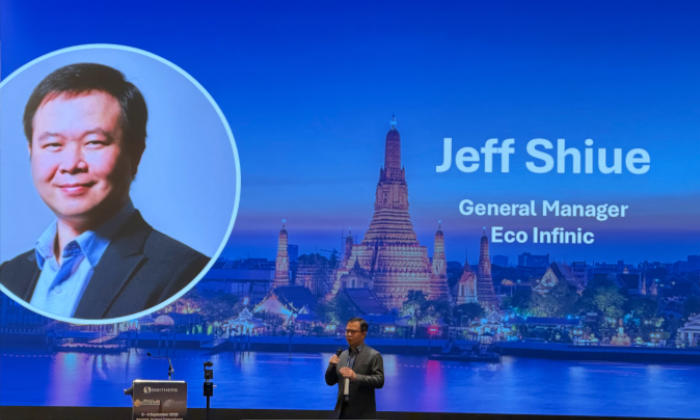
Photo by ECO Infinic.
On the stage
Jeff Shiue, General Manager of ECO Infinic, took part in the event's Speaker Interview program, where he laid out his view of what it will actually take for the recovered carbon black industry to grow up.
"At ECO Infinic, we believe that an industry is not fully mature until most companies can sustain themselves with positive cashflow. Achieving manufacturing economies of scale while producing stable rCB and TPO products that meet the quality demands of the largest off-takers is one of the best ways to achieve financial sustainability."
Jeff also delivered a technical session, "Commercial Scale Pyrolysis Chamber Design & rCB Performance in Tire Compounds," walking the audience through a head-to-head comparison of ECO Infinic's first- and second-generation pyrolysis reactors. Using six months of production data, the talk showed both generations landing within a tight band on toluene transmittance, ash content, and pH — then went a step further, testing the recovered carbon black itself in-rubber against the ASTM D3192 standard. The finding: once the two reactor generations' distinct processing parameters are accounted for, their rubber-reinforcement performance — tensile strength, tear strength, elongation at break, hardness — comes out very similar. The takeaway: recovered carbon black doesn't have to be a gamble on consistency if the process behind it is tightly controlled — a claim backed by six months of side-by-side production data, not just a promise.
On the show floor
ECO Infinic's role at the event went beyond a booth: the company spoke on stage, sat on the event's advisory board, and came on as a sponsor — sharing the exhibitor and sponsor lineup with names like DoRight, Fornnax, RCB Nanotechnologies, KBR, Birla Carbon, Powerol, Neuman & Esser, HITEC Luxembourg, Gangjin Engineering, Hosokawa Micron Group, and Ecomak. It's a roster that spans reactor OEMs, recyclers, and downstream processors from across the recovered-material supply chain — a sign of how crowded, and how serious, this space has gotten.
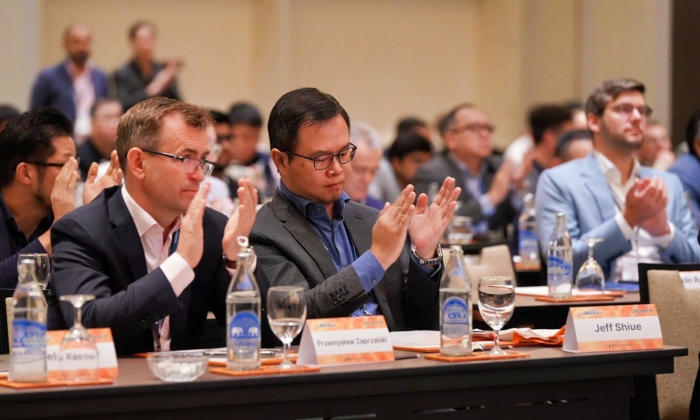
Photo by ECO Infinic.
At the booth itself, the story was tactile rather than theoretical. Visitors could see and handle physical samples covering the full output of ECO Infinic's process — pyrolysis oil, recovered carbon black, recovered steel wire, tire cotton, tire chips, and a whole end-of-life tire — laid out side by side, from feedstock to finished material. A wetsuit mounted alongside the samples carried the customer case directly: 100% of SHEICO's wetsuits are made with ECO Infinic's Recovered Carbon Black — a concrete, named proof point rather than a generic sustainability claim.
The real energy of the show, though, showed up between sessions. Coffee and lunch breaks turned the floor into an extension of the agenda rather than a pause from it — conversations ranged from where the recovered carbon black industry actually stands today, to where it's headed next, to the technical and quality gaps still standing between "recovered" and "specification-grade," and, more than once, to the geopolitics behind it: trade flows, tariffs, and import rules that increasingly decide where recycled material can and can't move. For a still-young industry, that kind of hallway debate is as telling as anything said from the stage.
The Core Message: consistency, batch to batch
Across both the stage session and booth conversations, one theme came up more than any other: the industry is no longer asking whether recovered carbon black is real — it's asking whether it's reliable, batch after batch. ECO Infinic's answer centers on its investment in process technology: tighter process control, continuous monitoring and adjustment during production, and full data records for every batch. It's a deliberate bet that consistency, not just recovery, is what turns recovered carbon black from a promising material into one the tire industry can specify with confidence.
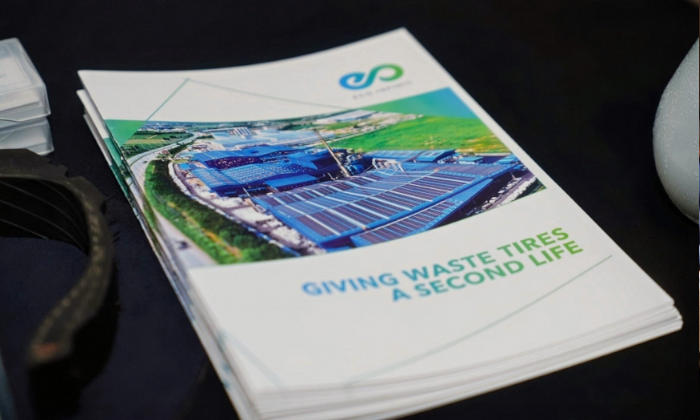
Photo by ECO Infinic.
Pre- and Post-Event: opening the doors in Chonburi
Around the show, ECO Infinic hosted pre- and post-event site visits at its facility in the Pinthong Industrial Estate, Chonburi, welcoming current suppliers, traders, and potential partners for a firsthand look at the operation: Weibold, Smithers, Wolfersdorff Consulting, and Hosokawa among others. For a company whose pitch rests on process control and data, letting people see the reactors running in person is the natural extension of the message delivered on stage.
What's next
The clearest signal from the show floor: interest in recovered carbon black has moved past "is this real" to "show me the data and let me see it running." ECO Infinic is following up individually with the professionals it met over the two days, and continues to open its Pinthong, Chonburi facility to qualified site visits for buyers who want to see the process — not just the sample — before they commit.
If your team was at Recovered Carbon Black Asia 2026 and didn't get a chance to talk, or you'd like to arrange a site visit, reach out at info@eco-infinic.com or www.eco-infinic.com.
ECO Infinic Co., Ltd. recovers carbon black, oil, and steel from end-of-life tires at its Pinthong, Chonburi facility, certified to ISO 9001, ISO 14001, ISO 14067, ISCC PLUS, ISCC EU, and Green Industry Level 3, with an EcoVadis sustainability score of 55/100.
Weibold is an international consulting company specializing exclusively in end-of-life tire recycling and pyrolysis. Since 1999, we have helped companies grow and build profitable businesses.