Sunshine Coast trial shows OTR tire crumb rubber can support lower-emission roads

A Sunshine Coast Council road trial in Queensland has demonstrated that crumb rubber produced from off-the-road tires can be used in asphalt and bitumen applications with performance comparable to conventional tire-derived crumb rubber, while a new lifecycle assessment indicates potential greenhouse gas savings when the modified pavement achieves a longer service life. The demonstration used crumb rubber produced entirely from OTR tires sourced from local construction equipment and incorporated it into several pavement treatments across Perlan Street, Railway Parade and Spalls Road. Twelve-month performance results found that OTR crumb rubber could be substituted for conventional crumb rubber without significant changes to asphalt production or placement, while laboratory testing indicated improved resistance to aging and environmental cracking. A 2026 lifecycle assessment by the National Transport Research Organisation found that although some crumb rubber-modified pavements have higher initial embodied emissions, longer service life and reduced maintenance could lower whole-of-life greenhouse gas emissions by up to 20% under the scenarios studied.
Trial targets difficult off-the-road tire waste stream
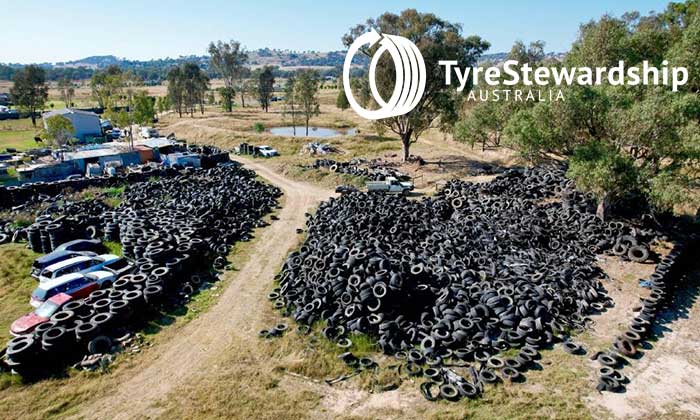
Off-the-road tires are widely used in mining, agriculture and construction and are particularly challenging to recycle because of their size, durable construction and the remote locations where they are often used. Tyre Stewardship Australia reports that less than 15% of Australian OTR tires are recovered, with onsite burial and stockpiling remaining common management routes.
The Sunshine Coast project examined whether rubber recovered from these tires could instead become a raw material for road construction, creating a higher-value domestic market for a waste stream that has historically had relatively few recycling outlets.
OTR crumb rubber tested at three Sunshine Coast sites
The project began in 2024 and involved Sunshine Coast Council, the Australian Flexible Pavement Association, Boral, Allens Asphalt, Carroll Engineering Services, Puma Bitumen and RMIT University. Tyre Stewardship Australia contributed $99,000 through its Market Development Fund.
OTR tires supplied from a local Boral quarry were processed by Carroll Engineering Services into crumb rubber. The recycled rubber was subsequently incorporated into crumb rubber-modified bitumen and asphalt used on Sunshine Coast Council roads, creating a local circular supply chain from end-of-life tire to finished pavement.
Trial confirms OTR rubber can replace conventional crumb rubber
The project found that crumb rubber manufactured from OTR tires could be used interchangeably with conventional crumb rubber without requiring significant changes to asphalt manufacturing or road placement processes.
The trial used gap-graded and other crumb rubber-modified asphalt mixtures containing OTR-derived crumb rubber. The lifecycle assessment subsequently examined eight pavement treatments across Perlan Street, Railway Parade and Spalls Road, comparing the recycled rubber alternatives with conventional and polymer-modified reference pavements.
Testing indicates improved resistance to aging and cracking
Performance testing found that the crumb rubber-modified binder was less susceptible to ultraviolet aging and retained a more elastic response after aging than conventional bitumen. According to the project findings, these characteristics can improve resistance to environmental cracking and contribute to greater pavement durability.
The binder met the requirements of Austroads Technical Specification ATS 3110 for A18R across the properties assessed except segregation. Testing identified clumping after 48 hours of conditioning at 180°C, which the project said could be addressed through changes to blending methods, the use of compatibilizers and appropriate storage and handling procedures.
Lifecycle assessment examines eight pavement treatments
The National Transport Research Organisation completed a cradle-to-grave lifecycle assessment focused on greenhouse gas emissions. The study analyzed eight conventional and crumb rubber-modified pavement treatments installed at the three Sunshine Coast locations.
The crumb rubber mixes assessed in the study used binders containing 18% OTR crumb rubber. The analysis covered raw material production, transportation, road construction, periodic maintenance, demolition and transport of materials for end-of-life processing.
Material production dominates initial road emissions
The lifecycle assessment found that raw material extraction, transportation and manufacturing accounted for approximately 65% to 85% of upfront greenhouse gas emissions. Transport to the construction site and road construction itself represented a smaller share.
At Perlan Street and Spalls Road, where pavement thicknesses were broadly comparable, the crumb rubber-modified alternatives initially produced higher emissions than conventional asphalt because the modified binders had greater embodied carbon intensity. At Railway Parade, however, the polymer-modified reference pavement recorded higher upfront emissions largely because it required a thicker asphalt layer.
Longer road life changes whole-of-life carbon results
The assessment found that durability is the principal factor determining the environmental advantage of OTR crumb rubber asphalt. Although some modified mixes have higher emissions during initial construction, extending pavement life delays resurfacing and other maintenance activities, which can reduce total emissions over the road's lifecycle.
At Perlan Street, the analysis calculated greenhouse gas reductions of up to 12% if the crumb rubber pavement achieved 40% additional service life. At Railway Parade, the potential reduction reached 20% with a 40% service-life extension compared with the polymer-modified reference pavement.
Spalls Road scenarios show savings of up to 20%
At Spalls Road, the study examined crumb rubber-modified pavement at both 35 mm and 25 mm thicknesses. For pavement of broadly comparable thickness to the conventional reference, lifecycle greenhouse gas emissions could fall by up to 9% if service life increased by 50%.
The thinner 25 mm crumb rubber pavement showed greater potential savings, with the modeled reduction reaching up to 20% under a 50% service-life extension. The study therefore emphasizes that both pavement design and actual durability are critical when comparing environmental performance.
Carbon benefits depend on achieving durability assumptions
The lifecycle results are scenario-based rather than evidence that all crumb rubber roads will automatically reduce greenhouse gas emissions by the reported percentages. At Spalls Road, for example, the 35 mm crumb rubber pavement required approximately 35% to 40% additional service life to reach carbon parity with a conventional pavement of similar thickness.
At Railway Parade, only around 10% additional service life was required for the crumb rubber alternative to achieve greenhouse gas parity with the polymer-modified reference, partly because the crumb rubber pavement was 35 mm thick compared with 50 mm for the reference treatment.
Maintenance emerges as major source of lifecycle emissions
The study found that periodic resurfacing and heavy patching can make a substantial contribution to total lifecycle emissions. Extending pavement service life reduces the frequency of these interventions and therefore becomes the main mechanism through which crumb rubber-modified asphalt can deliver longer-term greenhouse gas savings.
This finding reinforces the importance of considering whole-of-life road performance rather than comparing materials only on the carbon footprint associated with initial construction.
Project creates local outlet for mining and construction tires
The Sunshine Coast demonstration also provides a circular economy model for regions generating large quantities of OTR tires. Tires were sourced locally, processed into crumb rubber and returned to productive use in local roads rather than being buried, stockpiled or transported long distances for treatment.
Tyre Stewardship Australia said the findings could provide other councils, mining companies, agricultural operators and tire recyclers with a pathway for developing new markets for OTR tire-derived rubber. Eleven Australian catchment areas have previously been identified as significant generators of used OTR tires, suggesting potential for similar regional recycling models.
Results support wider use of recycled tire rubber in roads
The project demonstrates that OTR tire rubber can technically enter an established market already used for recycled passenger, truck and bus tires. Combining local tire recycling with road procurement could create additional demand for crumb rubber while reducing reliance on stockpiling and burial of large mining, construction and agricultural tires.
The 12-month road performance findings and subsequent lifecycle assessment indicate that the strongest environmental case depends on achieving the durability benefits associated with crumb rubber-modified asphalt. If those longer service lives are realized in practice, OTR tire recycling in road construction could provide both a substantial material recovery route and measurable reductions in whole-of-life pavement emissions.
Original case study by Tyre Stewardship Australia. Lifecycle findings are based on the 2026 Life Cycle Assessment of Crumb Rubber Asphalt prepared by the National Transport Research Organisation for Tyre Stewardship Australia and Sunshine Coast Council.
Weibold is an international consulting company specializing exclusively in end-of-life tire recycling and pyrolysis. Since 1999, we have helped companies grow and build profitable businesses.