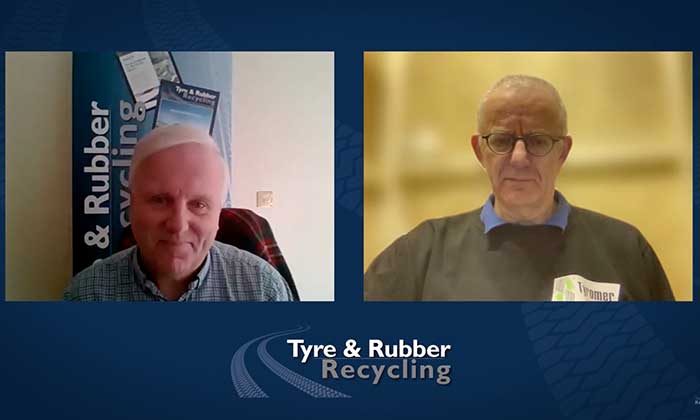
Tyromer's devulcanization team interviewed by Ewan Scott
Episode 21 of the Tyre Recycling Podcast features Jon Visaisouk from Canadian Tyromer – a successful devulcanization company who also expanded its operations to Europe
for your query 'ban '
Weibold stores an archive of hundreds of articles dedicated to the industry of tire recycling and pyrolysis. Search for specific news, events, used equipment ads and consulting services related to end-of-life tire recycling and pyrolysis.
Sponsored
Episode 21 of the Tyre Recycling Podcast features Jon Visaisouk from Canadian Tyromer – a successful devulcanization company who also expanded its operations to Europe

In 2024, SIGNUS managed a total of 222,406 tonnes of end-of-life tires (ELTs). Based on an average passenger tire weight of 8.1 kg, this equates to approximately 27,337,351 tires — enough to construct around 1,139 racetracks the size of the Jerez Circuit. Of the total volume collected, 12.5% was prepared for reuse as second-hand or retreaded tires. Nearly half (48.5%) was recycled into products for various applications, while the remaining 39% was used for energy recovery, mainly as a substitute for fossil fuels.

Tyre Stewardship Australia (TSA) – the end-of-life tire management authority in Australia – together with Keep Victoria Beautiful (KVB) are joining forces to help the Litter Enforcement Officer Network (LEON) tackle illegal dumping and stockpiling of waste tires in local environments.

The next BIR World Recycling Convention and Exhibition will take place from (26) 27 – 29 May 2024 in Copenhagen. The recycling market has been rocked by the European Commission’s decision to ban crumb rubber infill from use in synthetic turf surfaces at the end of an eight-year transition period. Therefore, the focus has shifted to alternative opportunities, with tyre pyrolysis attracting plenty of headlines, investment and imaginative thinking. Given the huge strides forward taken in this field over recent years, it will again form one of the main topics for debate at the upcoming BIR Tyres & Rubber Committee meeting to take place in Copenhagen on Tuesday May 28.

Tyre Stewardship Australia (TSA) welcomes the recent changes to the CO2 emission factor for end-of-life (EOL) tyres in the National Greenhouse and Energy Reporting (NGER) Scheme, taking effect 1 July 2022. Of the 460,000 tonnes of EOL tyres generated annually in Australia, if 100,000 tonnes were used to replace coal in fuel burning applications, this would represent a potential carbon dioxide reduction of 87,000 tonnes and would make a substantial contribution to Australia’s greenhouse gas abatement programme.

This time, Episode 64 of the Tyre Recycling Podcast features Part 2 of the Tyre Recycling Panel Discussion recorded at the Circular Economy Forum during The Tire Cologne event. In this episode, Ewan Scott, Stephan Rau and Frank Cremer discuss the potential of brand only recycling; the barriers to rubberised asphalt; and the issue of crumb rubber infill and its replacement; and the challenge of dealing with OTR tyres.

In December 2020, the European Recycling Industries’ Confederation – the umbrella organisation for European Recycling Industries – published a brochure on mechanical tire recycling highlighting the organization’s contribution towards circular economy and climate neutrality. EuRIC Brochure presents key facts about mechanical end-of-life tire recycling, which is a major enabler of circularity and climate mitigation for the entire tire value chain. The Brochure describes the current state of play of ELT management with recommendations to overcome key challenges faced by the European mechanical tire recycling industry be them embedded in legislation, market failures or eco-design. It features key numbers outlining the economic importance of the ELT recycling sector as well as its benefits for the environment and society.

Episode 70 of The Tyre Recycling Podcast features Peter Taylor, delving into the challenges and opportunities within the UK tyre recycling industry. The discussion highlights issues such as the need for regulatory enforcement, the delays in addressing T8 legislation, and the potential impacts of Extended Producer Responsibility (EPR) without proper underpinning. Taylor also emphasizes the importance of addressing carbon footprints from reimported products and ensuring feedstock security for future recycling initiatives.

The municipal asphalt campaign includes 38 planned interventions on public roads such as Camino del Molino and the streets Galicia, Grecia, Murcia, Luis Sauquillo and Andalucía. The works will cover interdistrict and local roads, as well as deteriorated roundabouts. The project includes milling and asphalt paving, along with complete repainting of road markings and curbs. The city said the works are intended to improve the road surface across several areas of Fuenlabrada.
Sponsored